The Obama Administration in Their Own Words

Politics is a messy, convoluted affair, and understanding its many debates and controversies usually requires steady news consumption, a working knowledge of dueling philosophies, and familiarity with a daunting array of statistics, laws, background, and mechanics that just don’t lend themselves to 5-second sound bites and 30-second TV spots.

But often, the offensiveness, idiocy, and hypocrisy of politicians’ words speak for themselves, and homework isn’t necessary for the average American to see how wrong they really are. The Obama Administration has many, many such quotes just waiting to scare voters into the waiting arms of Mitt Romney…if only Team Romney would have the good sense to use them.

If I were running Mitt’s campaign, one of the many things I’d do differently would be to take the below quotes (many of which come from John Hawkins’ excellent list), develop TV ads based around some of them, and list the rest in full-page newspaper ads, with one simple message:

“They don’t respect your values, your freedoms, your judgment, your lifestyles, your struggles, or your country. It’s time for leaders who do. Romney-Ryan 2012.”

Driving up our national debt from $5 trillion for the first 42 presidents — #43 added $4 trillion by his lonesome, so that we now have over $9 trillion of debt that we are going to have to pay back – $30,000 for every man, woman and child. That’s irresponsible. It’s unpatriotic.” – Barack Obama

“The way I think about it is this is a great, great country that had gotten a little soft, and we didn’t have that same competitive edge we needed over the last couple of decades.” – Barack Obama

“We’ve lost our ambition, our imagination, and our willingness to do the things that built the Golden Gate Bridge and Hoover Dam and unleashed all the potential in this country.” – Barack Obama

“I don’t believe it is possible to transcend race in this country.” – Barack Obama

“White folks’ greed runs a world in need.” – Barack Obama, quoting sentiments candidate Obama claimed to have never heard Rev. Jeremiah Wright express

“After my election I have more flexibility.” – Barack Obama, to Russian President Dmitry Medvedev

You go into these small towns in Pennsylvania and, like a lot of small towns in the Midwest, the jobs have been gone now for 25 years and nothing’s replaced them […] And it’s not surprising then they get bitter, they cling to guns or religion or antipathy toward people who aren’t like them or anti-immigrant sentiment or anti-trade sentiment as a way to explain their frustrations.” – Barack Obama

“We can’t drive our SUVs and eat as much as we want and keep our homes on 72 degrees at all times…and then just expect that other countries are going to say OK. That’s not leadership. That’s not going to happen.” – Barack Obama

Under my plan of a cap and trade system, electricity rates would necessarily skyrocket.” – Barack Obama

“Whether we like it or not, we remain a dominant military superpower.” – Barack Obama

I don’t think we’re going to be able to eliminate employer coverage immediately. There’s going to be potentially some transition process.” – Barack Obama

“Maybe you’re better off not having the surgery, but taking the painkiller.” – Barack Obama, to a woman whose mother was initially denied a pacemaker

“I’m always struck by people who think, well, it must be because I was just so smart. There are a lot of smart people out there. It must be because I worked harder than everybody else. Let me tell you something: there are a whole bunch of hardworking people out there. If you were successful, somebody along the line gave you some help. There was a great teacher somewhere in your life. Somebody helped to create this unbelievable American system that we have that allowed you to thrive. Somebody invested in roads and bridges. If you’ve got a business – you didn’t build that. Somebody else made that happen.” – Barack Obama

“I do think that at a certain point you’ve made enough money.” – Barack Obama

“I actually believe in redistribution.” – Barack Obama

“We are God’s partners in matters of life and death.” – Barack Obama

“Answering that question [when babies get human rights] with specificity is above my pay grade.” – Barack Obama

I’ve got two daughters. 9 years old and 6 years old. I am going to teach them first of all about values and morals. But if they make a mistake, I don’t want them punished with a baby.” – Barack Obama

In America, there’s a failure to appreciate Europe’s leading role in the world. Instead of celebrating your dynamic union and seeking to partner with you to meet common challenges, there have been times where America has shown arrogance and been dismissive, even derisive.” – Barack Obama

“‘You’re telling me we have to go spend money to keep from going bankrupt?’ The answer is yes, that’s what I’m telling you.” – Joe Biden

“You share a similar concern here in China. You have no safety net. Your policy has been one which I fully understand – I’m not second-guessing – of one child per family [through forced sterilization and abortion].” – Joe Biden

Look, the Taliban per se is not our enemy. That’s critical. There is not a single statement that the president has ever made in any of our policy assertions that the Taliban is our enemy.” – Joe Biden

In things racial we have always been and I believe continue to be, in too many ways, essentially a nation of cowards.” – Attorney General Eric Holder

“Somehow we have to figure out how to boost the price of gasoline to the levels of Europe.” – Energy Secretary Stephen Chu

“We are taking away a choice that continues to let people waste their own money.” – Energy Secretary Stephen Chu

“The American public…just like your teenage kids, aren’t acting in a way that they should act.” – Energy Secretary Stephen Chu

“It would even be possible to require pregnant single women to marry or have abortions, perhaps as an alternative to placement for adoption, depending on the society.” – Science Czar John Holdren

“Sounds like a dumb law…but I think that the question of whether it’s a dumb law is different from the question of whether it’s constitutional, and I think that courts would be wrong to strike down laws that they think are senseless just because they’re senseless.” – Justice Elena Kagan, on whether Congress has the power to force people to eat vegetables

America is “just downright mean.” – Michelle Obama

“For the first time in my adult life I am proud of my country.” – Michelle Obama

“Sometimes it’s easier to hold on to your stereotypes and misconceptions. It makes you feel justified in your own ignorance. That’s America.” – Michelle Obama

“What I notice about men, all men, is that their order is me, my family, God is in there somewhere, but me is first.” – Michelle Obama
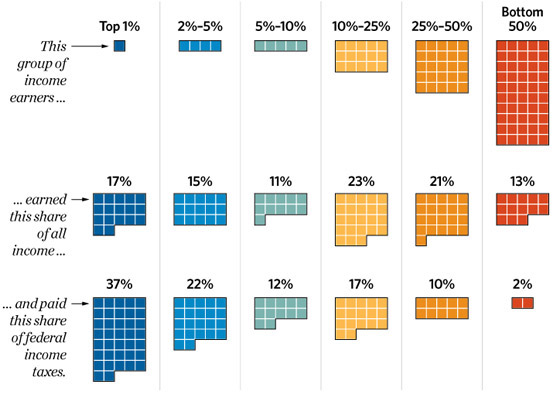
Understanding Redistribution and Class Warfare in One Chart

David French includes the above chart in his excellent post on America’s dependency problem. It illustrates the true breakdown of federal income taxes by income level more intuitively than anything I’ve seen in recent memory. Everyone should spread it on their social networks and save a copy to their computers, phones, iPods, Kindles, etc. to keep on hand for sharing with friends who don’t know the facts. Because apparently the RNC and the Romney Campaign – the guys with money and ad space – can’t be bothered to produce something so useful themselves and get it out there…

New Prager University Video: The Moral Case for the British Empire

Is there a moral case to be made for the British Empire? To even ask the question at your typical university would be to invite derision. That’s a shame because the British Empire’s legacy is one Western Civilization should be proud of. We’d be living in a much less free and prosperous world without it. Historian HW Crocker III explains why in this eye-opening Prager University course.

What Aren’t Your Kids Learning About America?

Conservative critics of left-wing bias in public education have noshortageofhorrorstoriesto make their point, such as Tanya Dixon-Neely, the North Carolina teacher who is keeping her job despite getting caught on tape in May berating a student for criticizing Barack Obama and telling the class they could get arrested for bad-mouthing their presidents.
But the more pervasive danger to future generations’ political understanding is subtler than outright indoctrination. Even when teachers aren’t out to push an agenda, social studies courses tend to take a superficial approach that may relay key historical events adequately, but provides only the most superficial understanding of the theories and values behind them, if at all.
Don’t believe me? Here are a few simple questions you can ask your kids to judge for yourself just how well served they’ve been in their Social Studies classes:
1.) Who was John Locke, and what did he contribute to the Founding? Despite dying seventy-two years before the Declaration of Independence, the great English philosopher could be thought of as the first Founder, since his writings established the natural right and social compact theories at the Declaration’s heart. Thomas Jefferson’s formulation that “ all men are created equal, that they are endowed by their Creator with certain unalienable Rights, that among these are Life, Liberty and the pursuit of Happiness,” and “that to secure these rights, Governments are instituted among Men, deriving their just powers from the consent of the governed” is basically the Cliff Notes version of Locke’s Second Treatise of Civil Government, which proposed consent as government’s only moral justification because nobody has a divine claim over anyone else, protecting individual rights as government’s just purpose, and developed a rational basis for objectively defining what is and is not a right.
2.) What is the significance of the Federalist Papers? Written by James Madison, Alexander Hamilton, and John Jay to persuade the new nation to adopt the Constitution, there is no more authoritative guide to our government—and yet, to most students, it’s a footnote at best. They’re denied some of the Founders’ most important lessons, like Federalist 10on the dangers of faction (groups “ actuated by some common impulse of passion, or of interest, adversed to…the permanent and aggregate interests of the community”), Federalist 45 on the difference between federal and state roles (“The powers delegated by the proposed Constitution to the federal government are few and defined. Those which are to remain in the State governments are numerous and indefinite”), Federalist 51 on human nature’s implications for politics (“If men were angels, no government would be necessary. If angels were to govern men, neither external nor internal controls on government would be necessary”), or the papers’ extensive analysis of the vital difference between direct democracy and the constitutional republic America was designed as. The Federalist Papers reveal that there’s careful thought and important purpose behind every aspect of our Constitution, yet the average high-schooler is likely to graduate with the impression that constitutional mechanics like the Electoral College, separation of powers, and bicameralism were either mere products of sectional compromise or the outdated fallacies of old, white elites.
3.) How did the Founders treat slavery? Conventional wisdom paints the Founders as simply hypocrites who proclaimed liberty for themselves while denying it to blacks. But while the stain of slavery on our history is real, our forefathers’ indifference on the subject is not. Slaveholders held enough power to keep the practice alive, but the Founders overwhelmingly opposed and condemned it. Consider the Three-Fifths Compromise. Everybody knows the constitutional provision that counts slaves as three-fifths of a whole person for purposes of apportioning House seats, but how many know that it was the slaveholders who wanted their slaves to be counted fully, so they could reap the benefits of additional Congressmen who would vote with pro-slavery interests, like the preservation of slavery, fugitive slave laws, and support for slavery in the territories? By counting them as three-fifths, the framers of the Constitution gave slave states lessinfluence over Congress than counting slaves fully would have, without completely alienating their willingness to ratify the Constitution. In fact, the compromise actually gave states an incentive to free their slaves: if their slaves became free men, they’d get more representatives.
Public schools may teach kids the whos, whats, wheres, and whens of American history and politics, but not the whys—an inexcusable inadequacy that denies them what they need most to become civic-minded adults, and demands much greater attention in America’s education debate.

New Prager University Video: Proving Media Bias

Check out the latest video from Dennis Prager’s fantastic Prager University series. Here, UCLA Political Science Professor  Tim Groseclose (author of Left Turn: How Liberal Media Distorts the American Mind) “explains his peer-reviewed study, which quantifies how slanted America’s news media really is. He says that if it were not for the media’s significant leftward bias, Americans would almost certainly vote more conservative.”

The Historical Malpractice of Equating Gay Marriage and Interracial Marriage

All liberal rhetoric has two basic goals: pander to some class-, sex-, or race-based voting bloc, and defame whoever disagrees with liberals. Nowhere is this more evident than in the same-sex marriage debate.

Perhaps in response to African-American pastors’ backlash against President Barack Obama’s endorsement of redefining marriage, the Left has resurrected the argument that opposing same-sex marriage is no different than forbidding interracial marriage, making today’s conservatives no better than yesterday’s racists. Today we remember with shame our ancestors who senselessly kept white and black lovers apart, the argument goes; how are those trying to prevent gay marriage any better?

It’s a powerful question—to those who don’t know anything about either the marriage debate or the history of anti-miscegenation (interracial marriage) laws. Fortunately, a little knowledge is more than enough to expose this attack for the cheap demagoguery it is.

For starters, race is a superficial characteristic having nothing to do with marriage’s meaning, while gender has everything to do with it. Men and women uniquely complement one another both as lovers and as parents, because theirs is the only pairing that naturally creates children and gives children what they need for a well-rounded upbringing. Children need role models of both genders in order to understand themselves and relate to the opposite sex. They need one parent to reinforce their sex’s strengths and another to temper its weaknesses. They need a mother’s disposition to nurture and a father’s emphasis on discipline. Numerous studies confirm this. Moms and dads come in all skin colors, but only women can be mothers, and only men fathers, which gives traditional marriage a clear rationale: binding together naturally procreative couples for the sake of their potential children.

Conversely, anti-miscegenation wasn’t motivated at all by substantive concerns about marriage’s function; it was merely one front in a much broader campaign to keep the black population oppressed and the white gene pool pure.

Marriage defenders’ motives couldn’t possibly be further from those of segregationists, and neither could the impact of their policies on the group in question. Defining marriage as a man-woman union simply means the state won’t issue marriage licenses to same-sex couples. That’s it. No prohibition whatsoever on cohabitation, sex, benefits (which can be addressed without redefining marriage), contracts, or even wedding ceremonies. The central motivation of marriage redefiners isn’t to correct a tangible injustice, but to win government endorsement for gay relationships—in other words, they’re driven by the subjective value they place in marriage’s symbolism.

The effects of the anti-miscegenation laws that once plagued interracial couples, on the other hand, were all too tangible. While some states simply denied their relationships formal recognition but otherwise left them alone, many criminalized—and punished—cohabitation, sex, and the performing of wedding ceremonies between whites and non-whites. Indeed, consider the incident that sparked Loving v. Virginia, the 1967 Supreme Court decision that struck down anti-miscegenation. Richard and Mildred Loving married in the District of Columbia, moved to Virginia, and were indicted. The judge gave them a choice: spend a year in prison, or get out of Virginia.

Jail time? Forced eviction from a state? Where in any of the thirty-eight states that reject same-sex marriage do gay couples face anything of the kind?
The comparison between same-sex and interracial marriage is historical malpractice of the worst order, a malicious lie that not only derails an important cultural conversation but also insults those who faced true bigotry in this country. This superficially clever smear might be a hit among clueless college kids receptive to whatever boosts their own sense of superiority, but liberals may see it backfire among voters with longer memories.

A Vital Healthcare Roadmap for Mitt Romney

Though constitutionally indefensible, Chief Justice John Roberts’ decision to save ObamaCare might prove to be a blessing in disguise. By guaranteeing that the intensely unpopular law stays relevant through November, the ruling could ultimately save the Constitution by securing Barack Obama’s electoral defeat.
That is, if Mitt Romney seizes the opportunity.
Therein lies the problem: so far, Team Romney has played it dangerously safe, campaigning on a one-note economic message that has frustrated many of his supporters into asking him, as the Weekly Standard’sBill Kristol did on July 5, “to get off autopilot and actually think about the race he’s running.”
The problem is amplified on healthcare. Throughout the primary, conservative activists excoriated Romney for the mandate-based plan he enacted in Massachusetts, decrying it as statism and fearing it would make Romney a hypocrite in attacking ObamaCare, leaving the campaign terrified of getting specific enough to invite comparisons of the two laws.
But that caution isn’t just excessive—it’s suicidal. As dissatisfied as voters are with the status quo, they know there’s more to it than the economy. And the case against the dangers of Obama’s second term is fatally incomplete without ObamaCare.
Contrary to the wisdom of overpaid GOP strategists, Mitt Romney can forcefully, comprehensively make that case—and contrary to the hysterics of the Anybody-But-Mitt crowd, he can do it without flip-flopping on RomneyCare.
First, stress that ObamaCare is full of outrages that have no parallel in RomneyCare. For instance, the Congressional Research Service says it’s impossible to count how many new agencies and boards the law creates, making their potential harm unknowable and their accountability impossible. Hammer the scandalous irresponsibility of Democrats inflicting on us something noneofthemevenread, much less understand. Note that the Congressional Budget Office now says the whole shebang is now projected to cost anywhere from $1.76 trillion to $2.6 trillion over the next decade—considerably higher than its original $900 billion price tag. Think that’ll help our $15+ trillion debt, America?
Second, sound the alarm on how ObamaCare will worsen healthcare. Trumpet the results of surveys like the one Jackson Healthcare releasedin June, which found that 70% of doctors don’t think it’ll control costs, 61% doubt it’ll improve the quality of care, and 66% expect it to take decisions out of physicians’ hands; or the one the Doctor Patient Medical Association releasedin July finding that ObamaCare has led 83% of American doctors to consider quitting. Point out that it makes completely dropping insurance the most affordable option for many employers. Explain how it makes insurance costlier to micromanage what services plans must cover.
Third, debunk the lie that Romney and Obama’s healthcare records are equivalent. For example, Romney’s proposal would only have required Massachusetts residents to purchase basic catastrophic insurance, to offset the cost of their federally-guaranteed right to emergency care, and would not have included any employer mandate—vastly different from ObamaCare’s much broader (and therefore far pricier) mandate, which imposes on employer and employee alike broader plans covering things like birth control, maternity care, and drug abuse treatment. It was Massachusetts’ 85% Democrat legislature, overriding Romney’s vetoes, which pushed RomneyCare leftward on these points (Romney also unsuccessfully vetoed the final bill’s coverage for non-citizens and a new bureaucracy it created, the Public Health Council).
Finally, point out the biggest difference of all: while Romney was merely out to insure the uninsured, Obama sees ObamaCare as one step on the longer road to a full-blown single-payer system. Demand the president explain what he meant when he said, “I don’t think we’re going to be able to eliminate employer coverage immediately. There’s going to be potentially some transition process.” Ask how that squares with “if you like your health care plan, you can keep your health care plan.”
Rather than a liability, the true story of RomneyCare contrasts sharply with ObamaCare and illustrates the formidable expertise Mitt Romney would bring to healthcare reform as president. But only Romney can tell it.

ObamaCare: Liberty Lost the Battle, But the War’s More Winnable Than Ever

Conservatives were right about John Roberts.
Not this year, obviously: nobody expected the Chief Justice to fall for the White House’s most laughable justification of ObamaCare’s individual mandate. But we were right in 2005, when George W. Bush nominated the blank-slate jurist to the Supreme Court. Ann Coulter warned us that “stealth nominees have never turned out to be a pleasant surprise for conservatives.” I’ve previously voiced my fear that Roberts worships at the altar of stare decisis.
Despite Roberts’ reasoning, the mandate is manifestly nota tax. As the bill’s text and legislative history clearly show, it’s a penalty expressly justified as a regulation of interstate commerce. Barack Obama himself emphatically denied that it was a tax. Hell, the Court itself acknowledged it’s not a tax—for the purpose of ruling on a different part of ObamaCare. As Anthony Kennedy’s dissenting opinion says, “to say that the Individual Mandate merely imposes a tax is not to interpret the statute but to rewrite it.” (To say nothing of the real elephant in the room: even if it was a tax, it still wouldn’t fall under enumerated powers.)
Jay Cost looks on the bright side: the Court rejected the mandate’s Commerce and Necessary & Proper Clause rationales, which sets valuable precedent. They also affirmed that states can’t be denied Medicaid funds for noncompliance.
That’s all well and good…but is one constitutional provision really protected when government can get away with the same thing by simply calling it something else? Brent Bozell is right: “there will be no rehabilitating” of John Roberts’ new image “as a traitor to his philosophy.” Thanks, Dubya!
Make no mistake: today was a defeat for constitutional fidelity, individual liberty, limited government, and true healthcare reform. But the American people may yet have the last laugh.
The general public deeply, deeply opposes ObamaCare, and doctors keep reaffirming that it’ll make American healthcare worse. The Court just guaranteed that a clear loser for Obama will remain a prominent issue throughout the rest of the campaign. We’re already seeing signs that conservatives are giving Mitt Romney a much-needed enthusiasm boost.
Beyond that, the ruling added two brand-new wrinkles to the narrative, neither of which works to Team Obama’s benefit. First, the mandate can now be characterized as a tax increase, an argument Sen. Marco Rubio is already expertly deploying. Second, Obama now has a new circle to square: were you lying about the mandate not being a tax then, or are you lying now?
Hopefully Romney will incorporate these details into his rhetoric sooner rather than later (his pre-scripted reaction to the ruling desperately needs a tune-up). Either way, the bottom line is that it’s more important than ever for conservatives to dedicating ourselves to keeping the House, retaking the Senate, and—and here’s the part some conservatives still want to suicidally ignore—retaking the White House. Only by electing Mitt Romneycan we hope to repeal ObamaCare and appoint justices with greater respect for the Constitution.
Let’s get to work.

Scott Walker Stands Victorious as Wisconsin Embodies the Best of Democracy

They tried fleeing the state to indefinitely halt the legislative process. It failed. They poured all the hate they could into their demonstrations and propaganda. It failed. They tried intimidating legislators. It failed. They tried pressuring businesses into supporting them. It failed. They tried persecuting a judge. It failed. They tried demonizingRepublican financial contributors. It failed. They tried smearing the governor’s professional ethics and personal morality. It failed. They tried lying to the public about budgets and benefits. It failed. They tried flouting the law by judicial fiat. It failed. They had teachers commit fraud and indoctrinate their students. It failed. They tried hiding data that undermined their case. It failed. They even managed to get Voter ID out of the way to simplify election fraud. That failed. In total, they cost taxpayers over $9 million.

The motley alliance of union thugs, partisan sycophants, education establishment snobs, left-wing fanatics, and brainwashed college kids that came together to preserve government-employee unions’ stranglehold over Wisconsin took the best shot they had against Governor Scott Walker.

Well, their best just. Wasn’t. Good. Enough.

After more than a year of liberals justifying demagoguery and mob agitation with insipid chants of “this is what democracy looks like,” the state of Wisconsin reaffirmed its trust in Walker in a glorious display of actual democracy—not the shout-down-the-Special-Olympics kind, but the cast-votes-and-count-‘em-up kind.

Though the sore losers will never, ever admit it, June 5, 2012 may go down in history as the day Wisconsin proved America’s slide into fiscal ruin isn’t inevitable, that special interest groups aren’t invincible, and that greed and misinformation don’t have absolute dominion over the public consciousness.

Above all, Wisconsin proved that courage is still viable in American politics—that principled action to serve the long-term interests of the whole over the selfish desires of the loudest or the most well-connected doesn’t have to be a political death sentence.

Granted, the Wisconsin Left has by no means been destroyed (nor has the moderate wing of the GOP). The Democrats and their supporters won’t grow morally from the experience, and the unions are still a force to be reckoned with. But their veneer of invincibility is gone, and it’s never coming back. The conventional wisdom of American politics is being rewritten as we speak.

As conservatives go forward with their economic and social agendas, we also need to take measures to make sure the Left can’t put Wisconsin through this insanity again. In particular, we need to fight to reinstate Voter ID, reform the recall process so it can’t be exploited to punish policy decisions, and do somethingabout classroom indoctrination.

Be proud, Wisconsin. You showed America what democracy looks like at its best.