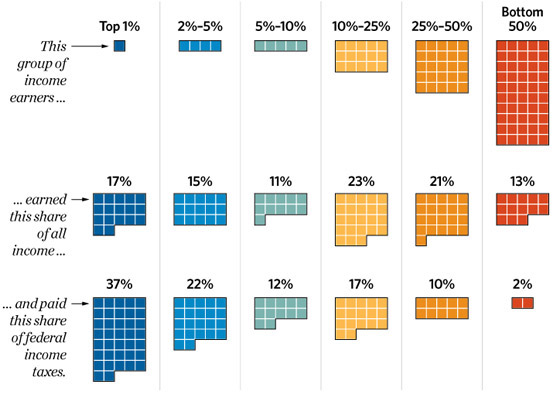
David French includes the above chart in his excellent post on America’s dependency problem. It illustrates the true breakdown of federal income taxes by income level more intuitively than anything I’ve seen in recent memory. Everyone should spread it on their social networks and save a copy to their computers, phones, iPods, Kindles, etc. to keep on hand for sharing with friends who don’t know the facts. Because apparently the RNC and the Romney Campaign – the guys with money and ad space – can’t be bothered to produce something so useful themselves and get it out there…
http://schemas.google.com/blogger/2008/kind#post
New Prager University Video: Do Higher Taxes Raise More Money?
In Prager University’s latest video, UCLA economics professor debunks one of the Left’s favorite economic fallacies.
New Prager University Video: The Moral Case for the British Empire
Is there a moral case to be made for the British Empire? To even ask the question at your typical university would be to invite derision. That’s a shame because the British Empire’s legacy is one Western Civilization should be proud of. We’d be living in a much less free and prosperous world without it. Historian HW Crocker III explains why in this eye-opening Prager University course.
What Aren’t Your Kids Learning About America?
Conservative critics of left-wing bias in public education have noshortageofhorrorstoriesto make their point, such as Tanya Dixon-Neely, the North Carolina teacher who is keeping her job despite getting caught on tape in May berating a student for criticizing Barack Obama and telling the class they could get arrested for bad-mouthing their presidents.
But the more pervasive danger to future generations’ political understanding is subtler than outright indoctrination. Even when teachers aren’t out to push an agenda, social studies courses tend to take a superficial approach that may relay key historical events adequately, but provides only the most superficial understanding of the theories and values behind them, if at all.
Don’t believe me? Here are a few simple questions you can ask your kids to judge for yourself just how well served they’ve been in their Social Studies classes:
1.) Who was John Locke, and what did he contribute to the Founding? Despite dying seventy-two years before the Declaration of Independence, the great English philosopher could be thought of as the first Founder, since his writings established the natural right and social compact theories at the Declaration’s heart. Thomas Jefferson’s formulation that “ all men are created equal, that they are endowed by their Creator with certain unalienable Rights, that among these are Life, Liberty and the pursuit of Happiness,” and “that to secure these rights, Governments are instituted among Men, deriving their just powers from the consent of the governed” is basically the Cliff Notes version of Locke’s Second Treatise of Civil Government, which proposed consent as government’s only moral justification because nobody has a divine claim over anyone else, protecting individual rights as government’s just purpose, and developed a rational basis for objectively defining what is and is not a right.
2.) What is the significance of the Federalist Papers? Written by James Madison, Alexander Hamilton, and John Jay to persuade the new nation to adopt the Constitution, there is no more authoritative guide to our government—and yet, to most students, it’s a footnote at best. They’re denied some of the Founders’ most important lessons, like Federalist 10on the dangers of faction (groups “ actuated by some common impulse of passion, or of interest, adversed to…the permanent and aggregate interests of the community”), Federalist 45 on the difference between federal and state roles (“The powers delegated by the proposed Constitution to the federal government are few and defined. Those which are to remain in the State governments are numerous and indefinite”), Federalist 51 on human nature’s implications for politics (“If men were angels, no government would be necessary. If angels were to govern men, neither external nor internal controls on government would be necessary”), or the papers’ extensive analysis of the vital difference between direct democracy and the constitutional republic America was designed as. The Federalist Papers reveal that there’s careful thought and important purpose behind every aspect of our Constitution, yet the average high-schooler is likely to graduate with the impression that constitutional mechanics like the Electoral College, separation of powers, and bicameralism were either mere products of sectional compromise or the outdated fallacies of old, white elites.
3.) How did the Founders treat slavery? Conventional wisdom paints the Founders as simply hypocrites who proclaimed liberty for themselves while denying it to blacks. But while the stain of slavery on our history is real, our forefathers’ indifference on the subject is not. Slaveholders held enough power to keep the practice alive, but the Founders overwhelmingly opposed and condemned it. Consider the Three-Fifths Compromise. Everybody knows the constitutional provision that counts slaves as three-fifths of a whole person for purposes of apportioning House seats, but how many know that it was the slaveholders who wanted their slaves to be counted fully, so they could reap the benefits of additional Congressmen who would vote with pro-slavery interests, like the preservation of slavery, fugitive slave laws, and support for slavery in the territories? By counting them as three-fifths, the framers of the Constitution gave slave states lessinfluence over Congress than counting slaves fully would have, without completely alienating their willingness to ratify the Constitution. In fact, the compromise actually gave states an incentive to free their slaves: if their slaves became free men, they’d get more representatives.
Public schools may teach kids the whos, whats, wheres, and whens of American history and politics, but not the whys—an inexcusable inadequacy that denies them what they need most to become civic-minded adults, and demands much greater attention in America’s education debate.
New Prager University Video: Proving Media Bias
Check out the latest video from Dennis Prager’s fantastic Prager University series. Here, UCLA Political Science Professor Tim Groseclose (author of Left Turn: How Liberal Media Distorts the American Mind) “explains his peer-reviewed study, which quantifies how slanted America’s news media really is. He says that if it were not for the media’s significant leftward bias, Americans would almost certainly vote more conservative.”
A Vital Healthcare Roadmap for Mitt Romney
Though constitutionally indefensible, Chief Justice John Roberts’ decision to save ObamaCare might prove to be a blessing in disguise. By guaranteeing that the intensely unpopular law stays relevant through November, the ruling could ultimately save the Constitution by securing Barack Obama’s electoral defeat.
That is, if Mitt Romney seizes the opportunity.
Therein lies the problem: so far, Team Romney has played it dangerously safe, campaigning on a one-note economic message that has frustrated many of his supporters into asking him, as the Weekly Standard’sBill Kristol did on July 5, “to get off autopilot and actually think about the race he’s running.”
The problem is amplified on healthcare. Throughout the primary, conservative activists excoriated Romney for the mandate-based plan he enacted in Massachusetts, decrying it as statism and fearing it would make Romney a hypocrite in attacking ObamaCare, leaving the campaign terrified of getting specific enough to invite comparisons of the two laws.
But that caution isn’t just excessive—it’s suicidal. As dissatisfied as voters are with the status quo, they know there’s more to it than the economy. And the case against the dangers of Obama’s second term is fatally incomplete without ObamaCare.
Contrary to the wisdom of overpaid GOP strategists, Mitt Romney can forcefully, comprehensively make that case—and contrary to the hysterics of the Anybody-But-Mitt crowd, he can do it without flip-flopping on RomneyCare.
First, stress that ObamaCare is full of outrages that have no parallel in RomneyCare. For instance, the Congressional Research Service says it’s impossible to count how many new agencies and boards the law creates, making their potential harm unknowable and their accountability impossible. Hammer the scandalous irresponsibility of Democrats inflicting on us something noneofthemevenread, much less understand. Note that the Congressional Budget Office now says the whole shebang is now projected to cost anywhere from $1.76 trillion to $2.6 trillion over the next decade—considerably higher than its original $900 billion price tag. Think that’ll help our $15+ trillion debt, America?
Second, sound the alarm on how ObamaCare will worsen healthcare. Trumpet the results of surveys like the one Jackson Healthcare releasedin June, which found that 70% of doctors don’t think it’ll control costs, 61% doubt it’ll improve the quality of care, and 66% expect it to take decisions out of physicians’ hands; or the one the Doctor Patient Medical Association releasedin July finding that ObamaCare has led 83% of American doctors to consider quitting. Point out that it makes completely dropping insurance the most affordable option for many employers. Explain how it makes insurance costlier to micromanage what services plans must cover.
Third, debunk the lie that Romney and Obama’s healthcare records are equivalent. For example, Romney’s proposal would only have required Massachusetts residents to purchase basic catastrophic insurance, to offset the cost of their federally-guaranteed right to emergency care, and would not have included any employer mandate—vastly different from ObamaCare’s much broader (and therefore far pricier) mandate, which imposes on employer and employee alike broader plans covering things like birth control, maternity care, and drug abuse treatment. It was Massachusetts’ 85% Democrat legislature, overriding Romney’s vetoes, which pushed RomneyCare leftward on these points (Romney also unsuccessfully vetoed the final bill’s coverage for non-citizens and a new bureaucracy it created, the Public Health Council).
Finally, point out the biggest difference of all: while Romney was merely out to insure the uninsured, Obama sees ObamaCare as one step on the longer road to a full-blown single-payer system. Demand the president explain what he meant when he said, “I don’t think we’re going to be able to eliminate employer coverage immediately. There’s going to be potentially some transition process.” Ask how that squares with “if you like your health care plan, you can keep your health care plan.”
Rather than a liability, the true story of RomneyCare contrasts sharply with ObamaCare and illustrates the formidable expertise Mitt Romney would bring to healthcare reform as president. But only Romney can tell it.
ObamaCare: Liberty Lost the Battle, But the War’s More Winnable Than Ever
Conservatives were right about John Roberts.
Not this year, obviously: nobody expected the Chief Justice to fall for the White House’s most laughable justification of ObamaCare’s individual mandate. But we were right in 2005, when George W. Bush nominated the blank-slate jurist to the Supreme Court. Ann Coulter warned us that “stealth nominees have never turned out to be a pleasant surprise for conservatives.” I’ve previously voiced my fear that Roberts worships at the altar of stare decisis.
Despite Roberts’ reasoning, the mandate is manifestly nota tax. As the bill’s text and legislative history clearly show, it’s a penalty expressly justified as a regulation of interstate commerce. Barack Obama himself emphatically denied that it was a tax. Hell, the Court itself acknowledged it’s not a tax—for the purpose of ruling on a different part of ObamaCare. As Anthony Kennedy’s dissenting opinion says, “to say that the Individual Mandate merely imposes a tax is not to interpret the statute but to rewrite it.” (To say nothing of the real elephant in the room: even if it was a tax, it still wouldn’t fall under enumerated powers.)
Jay Cost looks on the bright side: the Court rejected the mandate’s Commerce and Necessary & Proper Clause rationales, which sets valuable precedent. They also affirmed that states can’t be denied Medicaid funds for noncompliance.
That’s all well and good…but is one constitutional provision really protected when government can get away with the same thing by simply calling it something else? Brent Bozell is right: “there will be no rehabilitating” of John Roberts’ new image “as a traitor to his philosophy.” Thanks, Dubya!
Make no mistake: today was a defeat for constitutional fidelity, individual liberty, limited government, and true healthcare reform. But the American people may yet have the last laugh.
The general public deeply, deeply opposes ObamaCare, and doctors keep reaffirming that it’ll make American healthcare worse. The Court just guaranteed that a clear loser for Obama will remain a prominent issue throughout the rest of the campaign. We’re already seeing signs that conservatives are giving Mitt Romney a much-needed enthusiasm boost.
Beyond that, the ruling added two brand-new wrinkles to the narrative, neither of which works to Team Obama’s benefit. First, the mandate can now be characterized as a tax increase, an argument Sen. Marco Rubio is already expertly deploying. Second, Obama now has a new circle to square: were you lying about the mandate not being a tax then, or are you lying now?
Hopefully Romney will incorporate these details into his rhetoric sooner rather than later (his pre-scripted reaction to the ruling desperately needs a tune-up). Either way, the bottom line is that it’s more important than ever for conservatives to dedicating ourselves to keeping the House, retaking the Senate, and—and here’s the part some conservatives still want to suicidally ignore—retaking the White House. Only by electing Mitt Romneycan we hope to repeal ObamaCare and appoint justices with greater respect for the Constitution.
Let’s get to work.
Scott Walker Stands Victorious as Wisconsin Embodies the Best of Democracy
They tried fleeing the state to indefinitely halt the legislative process. It failed. They poured all the hate they could into their demonstrations and propaganda. It failed. They tried intimidating legislators. It failed. They tried pressuring businesses into supporting them. It failed. They tried persecuting a judge. It failed. They tried demonizingRepublican financial contributors. It failed. They tried smearing the governor’s professional ethics and personal morality. It failed. They tried lying to the public about budgets and benefits. It failed. They tried flouting the law by judicial fiat. It failed. They had teachers commit fraud and indoctrinate their students. It failed. They tried hiding data that undermined their case. It failed. They even managed to get Voter ID out of the way to simplify election fraud. That failed. In total, they cost taxpayers over $9 million.
The motley alliance of union thugs, partisan sycophants, education establishment snobs, left-wing fanatics, and brainwashed college kids that came together to preserve government-employee unions’ stranglehold over Wisconsin took the best shot they had against Governor Scott Walker.
Well, their best just. Wasn’t. Good. Enough.
After more than a year of liberals justifying demagoguery and mob agitation with insipid chants of “this is what democracy looks like,” the state of Wisconsin reaffirmed its trust in Walker in a glorious display of actual democracy—not the shout-down-the-Special-Olympics kind, but the cast-votes-and-count-‘em-up kind.
Though the sore losers will never, ever admit it, June 5, 2012 may go down in history as the day Wisconsin proved America’s slide into fiscal ruin isn’t inevitable, that special interest groups aren’t invincible, and that greed and misinformation don’t have absolute dominion over the public consciousness.
Above all, Wisconsin proved that courage is still viable in American politics—that principled action to serve the long-term interests of the whole over the selfish desires of the loudest or the most well-connected doesn’t have to be a political death sentence.
Granted, the Wisconsin Left has by no means been destroyed (nor has the moderate wing of the GOP). The Democrats and their supporters won’t grow morally from the experience, and the unions are still a force to be reckoned with. But their veneer of invincibility is gone, and it’s never coming back. The conventional wisdom of American politics is being rewritten as we speak.
As conservatives go forward with their economic and social agendas, we also need to take measures to make sure the Left can’t put Wisconsin through this insanity again. In particular, we need to fight to reinstate Voter ID, reform the recall process so it can’t be exploited to punish policy decisions, and do somethingabout classroom indoctrination.
Be proud, Wisconsin. You showed America what democracy looks like at its best.
New at Live Action – Joe Biden’s Selective Separation of Church and State
My latest Live Action post:
In a rather spectacular display of irony earlier this week, Vice President Joe Biden blasted the budget proposed by Rep. Paul Ryan (R-WI), which seeks to dramatically reduce federal spending, as a “contrary to the social doctrine” taught by the Catholic Church to which he belongs.That’s a gross oversimplification – you can see Ryan (who is also Catholic) defend his budget’s Catholic principles here, but the short version is that the faith’s call to care for the needy is not a mandate to support any specific government method of delivering aid. True Christian charity is giving your own time and money to a cause, not just casting a vote to have someone else handle it.But the real kicker, as Hot Air’s Ed Morrissey notes, is that this lecture on how to be a good Catholic politician is coming from someone who rejects his church’s call to recognize and protect life in the womb – an imperative which is far less ambiguous than Biden’s conception of social justice. Catholicism requires believers to support federal funding for specific government programs, but not legal protection for the most defenseless of God’s children?
Read the rest at Live Action.
In Which Our Feminist Betters Laud a Killer Communist
If liberals think they can score political points by tying their opponents to extremists, then I’ll see their latest example, Francis Grady, and raise them one Angela Davis.
Davis is a tenured University of California professor (of course), a self-professed Communist, a former Black Panther, and a likely accessory to the 1970 killing of Judge Harold Haley (she was acquitted despite over twenty witnesses, thanks to fellow Communists providing a dubious alibi and ideological brethren in the jury).
Though her primary causes are race and class, she’s found her way into the abortion debate thanks to a speech she delivered at the University of Kansas at the invitation of the February Sisters, the following passage of which feminist Pace University Law Professor Bridget Crawford highlights on her blog (though she omits what Davis “was in jail in Marin County” for):
I was asked to write a statement [for a San Francisco “reproductive rights” rally – CF] that very specifically engaged with the issue of abortion rights. Of course, I was in favor of women’s abortion rights, but I did not want to take women’s abortion rights out of the context of the broader conglomeration of issues that constitute women’s reproductive rights.
At that time, we had learned that vast numbers of Native American women had been sterilized. We’d also learned about the extent to which Puerto Rican women were used as guinea pigs by pharmaceutical companies in the production of what was then the new birth control pill. So, I wrote a statement in which I tried to make connections between women’s reproductive rights and women’s right to be free from forced sterilization. The statement wasn’t read.
My position was, I cannot talk about abortion rights in isolation from these other issues. I’ve come to understand that when we talk about feminist epistemologies, we speak precisely about the ability to think, together, about things that often do not cohabit the same analytical space.
While San Francisco pro-aborts certainly could have used a good reminder that there are far worse things in life than not being able to abort your offspring, that’s also what makes Davis’ position so twisted: her insistence that abortion is central to reproductive freedom on the same level as sterilization and unscrupulous medical testing. Abortion kills a separate human being the mother regrets creating, undoing something she could have easily prevented in the overwhelming majority of cases. Sterilization prevents a woman from every having children again. In what universe are they comparable?
This is perhaps the greatest sin of modern leftists who claim the mantle of feminism for themselves: the intertwining of a noble cause with greed and injustice, using the honor of the former as cover for the shame of the latter, deceiving and intimidating people into accepting the lie that allegiance to their agenda is the only way to escape the scarlet letter of “sexist.” And what more fitting personification of that sin than a radical who aligns with some of history’s worst monsters in the name of “rights”?
Granted, the average pro-choicer doesn’t support the Black Panthers or the Communists like Angela Davis does. Heck, I’m not sure the average pro-choicer even knows who Angela Davis is. But if pro-lifers are expected to answer every time a lone extremist acts in our name, then so-called “feminists” who invite Davis to speak at their events and cheerfully disseminate her “wisdom” should have to do the same.
